

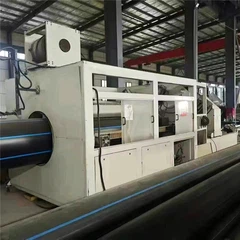
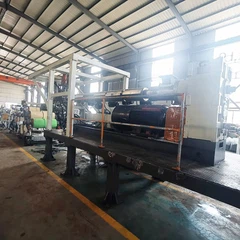
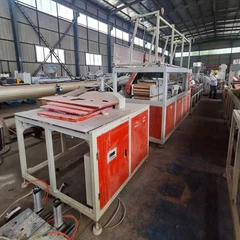
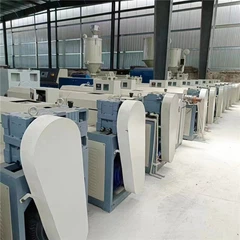

The key to producing high-stiffness tubing lies in controlling three critical factors: raw material formulation, equipment condition and configuration, and the manufacturing process.
Key Point 1: Ingredients and Formulation
Utilizing modified masterbatches: This is a highly practical technique. Research has shown that adding modified masterbatches with reinforcing and toughening properties to HDPE raw material can significantly enhance the mechanical strength of the final pipe. This is akin to giving older equipment a "performance-enhancing supplement"; even if the equipment's plasticizing capability is not top-tier, it can still produce pipes that meet or even exceed ring stiffness standards through formulation optimization. Some technologies can even enable corrugated pipes produced from recycled HDPE to achieve the performance levels of new material.
Fiber-reinforced technology: This is currently one of the most effective methods for enhancing pipe ring stiffness. By adding materials such as glass fiber or carbon fiber, ultra-high-strength pipes with ring stiffness exceeding 40 kN/m² can be produced. The manufacturing technology for fiber-reinforced pipes is already highly mature; as long as your used equipment is equipped with multi-layer co-extrusion or winding capabilities, you can produce products that far exceed national standards.
Key Point 2: Device Status and Configuration
Wear on core components is critical: High-rigidity pipes place extremely high demands on plasticizing pressure and stability. This brings us back to what we discussed last time: it is essential to rigorously inspect the wear on the screw and barrel. If the clearance is too large, melt pressure cannot be built up, plasticizing and mixing will be ineffective, and it will be impossible to produce high-quality pipes. This is the "1"; everything else is "0."
The "Hard Power" of the Die: Die design directly impacts the pipe's ring stiffness.
Wall Thickness Adjustment Device: It is best for production line dies to be equipped with a wall thickness adjustment device. This allows you to precisely control the uniformity of wall thickness when producing pipes from different raw materials or with varying ring stiffness requirements-a fundamental requirement for ensuring ring stiffness.
Special-Structure Dies: Some advanced die designs, such as using an arc structure at the peaks of corrugated pipes, can effectively increase the pipe's ring stiffness. If your used equipment happens to be equipped with such dies, it's like adding wings to a tiger.
Line-Wide Coordination: The production of high-rigidity pipes requires close coordination among all stages, including extrusion, cooling, drawing, and cutting. For example, a powerful cooling system is crucial for ensuring the proper shaping of thick-walled pipes.
Key Point 3: Manufacturing Process
"Mastery" at the molecular level: Both academia and industry are exploring how to "self-reinforce" pipes through manufacturing processes. For example, a technology called the Rotating Shear System (RSS) rotates the mandrel during extrusion, causing the HDPE molecular chains to align in the circumferential (hoop) direction of the pipe, forming a superstructure known as a "shish-kebab" structure. Research shows that this technology can boost the pipe's circumferential tensile strength by a staggering 338%! Although this technology has not yet become widespread, it points the way forward: arranging molecular chains more rationally is a more effective way to increase stiffness than simply increasing wall thickness.
Vibration-assisted extrusion: Similarly, equipment such as electromagnetic dynamic plasticizing extruders can significantly improve the pipe's circumferential strength by applying a vibrational force field, achieving bidirectional self-reinforcement of the pipe.
Precise Control of Process Parameters: Even without the advanced technologies mentioned above, precise control of cooling rates, melt temperature, and draw speed can optimize the crystalline morphology and internal structure of the pipe, balancing stiffness and toughness, and preventing embrittlement or cracking caused by excessive internal stress.