

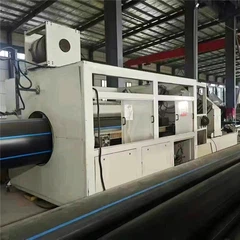
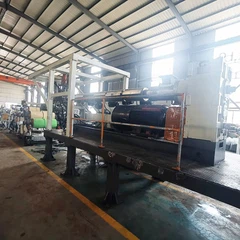
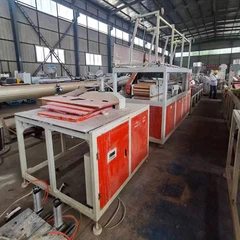
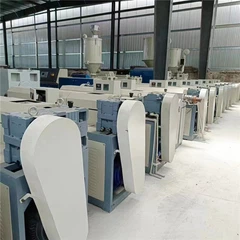

There are numerous factors that affect the precision of used pipe extrusion machines, which can be systematically categorized into four core dimensions: equipment hardware, process parameters, material properties, and production operations. Particularly for used equipment, the wear and tear of various components after prolonged use is a key factor in determining the precision of the finished product.
I. Equipment Hardware Condition
In used equipment, the impact of hardware wear on precision is particularly pronounced after prolonged use:
1. Screw and barrel wear: As core components, they inevitably experience wear after long-term use.
Symptoms and effects: The clearance between the screw and the barrel increases (the standard clearance is typically 0.1–0.3 mm), leading to melt backflow, unstable extrusion pressure and output, and fluctuations in pipe dimensions.
Key Indicator: If the depth of the screw grooves decreases by more than 10%, conveying capacity will drop significantly.
2. Declining mold precision and assembly issues: The mold is critical in determining the final shape of the pipe.
Symptoms and Effects: Poor concentricity between the die and mandrel (deviation exceeding 0.1 mm) directly causes uneven circumferential wall thickness and excessive ovality in the pipe. Additionally, charred material or scratches inside the mold can result in surface scratches or roughness on the pipe.
3. Issues with the drawing and cutting systems:
Symptoms and Effects: Unstable operation of the draw frame causes fluctuations in the pipe's speed during drawing, which is one of the primary causes of reduced longitudinal dimensional accuracy.
Key Indicators: Inaccurate cutting length measurement is typically related to the length measuring wheel not being pressed firmly (pressure should be 0.5–1.0 N) or fluctuations in draw speed.
II. Setting Process Parameters
Appropriate process parameters are essential for ensuring the precision of the finished product.
1. Temperature Control:
Symptoms and Effects: Temperatures that are too high or too low will affect melt flow. For example, if the die temperature is too low, the pipe's inner diameter will increase and the wall thickness will decrease; conversely, the inner diameter will decrease and the wall thickness will increase.
Key Indicators: Typically, the temperature difference between zones should be controlled within ±2°C; When processing PVC materials, the barrel temperature generally rises in a gradient between 180–220°C.
2. Matching Extrusion Rate and Pull-off Speed:
Phenomenon and Impact: A mismatch between the two directly leads to dimensional deviations. If the pull-off speed is too fast, the pipe will be "stretched thin" and become too thin; conversely, the melt will "accumulate," resulting in a pipe that is too thick.
Key Indicators: When producing pipes, the draw ratio is typically controlled between 1.02 and 1.05.
3. Pressure Fluctuations:
Symptoms and Effects: Unstable die pressure leads to uneven melt density, which ultimately affects the dimensions of the finished product.
Key Indicators: Die pressure fluctuations should be controlled within ±0.5 MPa. If fluctuations are significant, check the temperature, feed rate, and screen condition.
III. Material Properties and Processing
The condition and properties of the raw material itself are fundamental to the quality of the finished product.
Material Properties and Contamination: The melt index and thermal stability of the raw material directly affect the processing results. The presence of impurities or uneven mixing of materials from different batches can lead to unstable extrusion.
Moisture Content:
Symptoms and Effects: Excessive moisture vaporizes at high temperatures, causing bubbles on the inner wall of the pipe and a rough surface, which severely affects appearance and strength.
Key Indicator: Before production, ensure the moisture content of the raw material is below 0.2%.
IV. Production Operations and Maintenance
Proper operation and regular maintenance are essential for ensuring the long-term, stable operation of used equipment.
Pre-startup Inspection: Before production begins, the condition of the equipment must be checked, particularly the concentricity of the mold and whether the temperature sensors in each heating zone are functioning properly.
Adjustments During Operation: After the equipment has been running for some time, vibration may cause the mold adjustment screws to loosen; these must be checked and readjusted promptly. Additionally, ensuring that the traction rollers apply even pressure without slipping is key to maintaining dimensional stability.
Regular Maintenance: Regularly cleaning residue from the molds and filters and replacing worn parts are important measures for maintaining equipment performance and precision.