

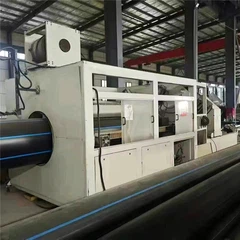
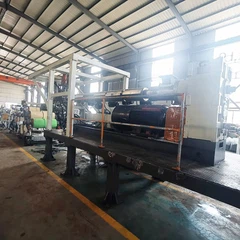
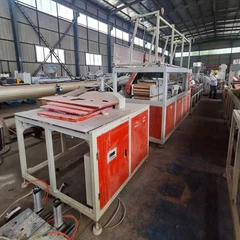
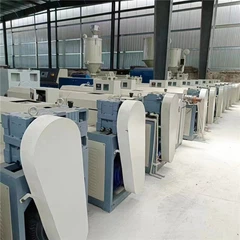

Detailed Explanation of Advantages
1.Unmatched Mixing and Dispersion Performance
Core Advantage: This is the most prominent and defining benefit of twin-screw extruders. The intermeshing motion of the two screws generates intense shearing, splitting, recombining, and reorienting effects, enabling materials-especially those with complex formulations-to achieve highly uniform mixing in an extremely short time. This is critical for processes such as filling, blending modification, reinforcement, and coloration.
2.Excellent Self-Cleaning Ability
In co-rotating twin-screw extruders, the threads and flutes at the intermeshing zone move in opposite directions, allowing them to wipe off adhered material from each other. This prevents material stagnation and degradation, making it especially suitable for processing heat-sensitive materials (such as PVC) or applications requiring frequent material changes.
3.Excellent Conveying and Feeding Capacity
Based on the principle of positive displacement conveying, it features high conveying efficiency and low dependence on the material's friction coefficient. As a result, it can stably feed difficult-to-handle materials such as powders, fibers, and low-bulk-density recycled materials, with minimal risk of slippage.
4.Excellent Conveying and Feeding Capacity
Based on the principle of positive displacement conveying, it features high conveying efficiency and low dependence on the material's friction coefficient. As a result, it can stably feed difficult-to-handle materials such as powders, fibers, and low-bulk-density recycled materials, with minimal risk of slippage.
5.Flexible Modular Design
Screws and barrels typically adopt a modular/block-type construction. By changing the sequence and combination of screw elements (such as conveying blocks, kneading blocks, toothed disks, etc.) and the number of barrel segments, the configuration can be "customized" to best suit specific processes, offering extremely high adaptability.
Disadvantages and Limitations
1.High Cost
High Initial Investment:Due to its complex structure, the manufacturing cost is much higher than that of single-screw extruders.
High Maintenance Cost:It contains many precision components, and the replacement cost is relatively high after wear.
2.Complex Structure with High Maintenance Requirements
Twin-screw extruders have extremely high requirements for assembly and alignment. The clearance between the screw and barrel is critical; improper maintenance can lead to accelerated wear or reduced performance.
3.Low and Fluctuating Discharge Pressure
Although it has strong conveying capacity, its ability to build stable pressure at the die head is inferior to that of single-screw extruders. In applications requiring extremely high and stable extrusion pressure (such as certain pipes and sheets), a single-screw extruder or a melt gear pump is often installed at the end for pressure boosting and stabilization.
4.Not All Processes Require It
For simple plasticizing extrusion, pelletizing or molding of pure resin (such as PE pipe extrusion), single-screw extruders can fully meet the requirements and are more economical. Using twin-screw extruders in such cases is overkill.