

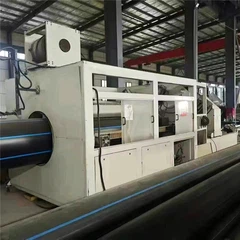
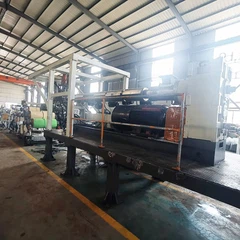
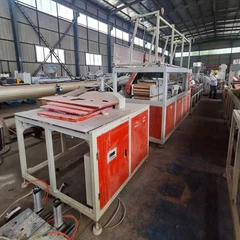
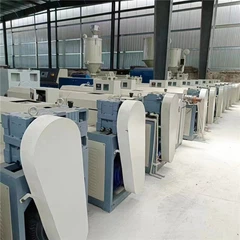

Core summary
The working principle of a single-screw extruder can be simply understood as a process in which a rotating screw continuously conveys, compresses, melts, mixes, homogenizes, and finally extrudes plastic melt at a constant rate within a heated barrel. Its core lies in the synergistic action between the screw and the barrel.
Main Components
1.Screw: The core component, typically divided into the feed section, compression section (melting section), and homogenizing section (metering section). Its geometric parameters (diameter, length-to-diameter ratio, channel depth, helix angle, etc.) determine the machine's performance.
2.Barrel: A metal cylinder enclosing the screw, equipped with internal heaters and a cooling system to provide heat for the material and ensure precise temperature control.
3.Die Head: Mounted at the end of the extruder, it imparts the final cross-sectional shape to the extruded product (e.g., pipes, sheets, films, profiles, etc.).
Detailed Process of the Working Principle
Stage 1: Solid Conveying Section (Feed Section)
Location: The part of the screw near the hopper.
Function: To stably and continuously convey loose solid particles (or powder) forward.
Principle:
The material fills the screw channel and is captured by the rotating screw.
Since the friction between the material and the screw is less than the friction between the material and the inner wall of the barrel, as the screw rotates, the material is "dragged" forward along the inner wall of the barrel, much like a nut.
The channel depth in this section is typically the deepest, with a constant volume. It mainly performs physical conveying; the material remains mostly solid, with a slow temperature rise.
Stage 2: Melting Section (Compression Section)
Location: The middle part of the screw.
Function: To compact, soften, and completely melt solid material into a viscous flow state, while expelling entrained air.
Principle:
The screw channel depth decreases from deep to shallow, creating a compression ratio. The material is forcibly compressed, its density increases, and interparticle voids are eliminated.
Under the combined effect of external heating (provided by the barrel) and internal frictional heat (generated by shear between the material, screw, and barrel), the material temperature rises rapidly to the melting temperature.
Melting starts from the material near the inner wall of the barrel, forming a melt film, which is scraped off by the screw flights and collected into the screw channel to form a melt pool. The solid bed (unmelted material) is gradually squeezed until it disappears, eventually converting entirely into melt.
This is the critical stage for achieving the phase transition of the material.
Stage 3: Melt Conveying Section (Homogenizing Section / Metering Section)
Location: The frontmost part of the screw, near the die head.
Function: To further homogenize, mix, and pressurize the melted material, and establish a stable pressure to extrude it from the die head at a constant temperature, constant rate, and constant pressure.
Principle:
The channel depth in this section is the shallowest and constant, exerting a strong shearing effect on the melt.
Intense shearing promotes uniform mixing of components (e.g., pigments, additives) and temperature homogeneity.
The pumping pressure generated by screw rotation is used to overcome the high resistance of the die head, ensuring stable and continuous melt flow through the die.
The output and stability of the extruder are mainly determined by this section.
Its basic working process is similar to that of a manual meat grinder or pasta maker we use in daily life: the material is fed in, pushed forward by a rotating screw, and under the action of compression and external heating, it changes from a solid state into a uniform viscous fluid, which is then continuously extruded from a die head of a specific shape.