

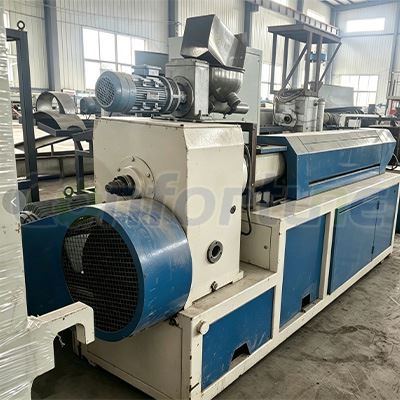
Hey there! As a supplier of used twin screw extruders, I often get asked about back - pressure in these machines. So, let's dive right into what back - pressure is and why it's important in a used twin screw extruder.
First off, what exactly is back - pressure? Well, in simple terms, back - pressure is the resistance that the material being processed in the extruder encounters as it moves through the die or other restrictive elements at the end of the extruder barrel. It's like when you're trying to push water through a narrow pipe; the narrower the pipe, the more resistance you'll feel. In a twin screw extruder, this resistance is created by the die, screen packs, or any other components that limit the flow of the molten plastic.


Now, why is back - pressure so crucial? Back - pressure plays a vital role in ensuring the quality and consistency of the extruded product. When there's an appropriate amount of back - pressure, it helps to homogenize the melt. This means that all the components in the plastic blend are evenly distributed, resulting in a more uniform and high - quality final product. For example, if you're extruding a plastic pipe, proper back - pressure will make sure that the wall thickness of the pipe is consistent throughout its length.
Another important aspect is that back - pressure affects the output rate of the extruder. If the back - pressure is too low, the plastic may flow too quickly through the extruder, leading to incomplete mixing and a lower - quality product. On the other hand, if the back - pressure is too high, it can put excessive stress on the screws and other components of the extruder, potentially causing damage and reducing the machine's lifespan.
So, how do you control back - pressure in a used twin screw extruder? There are a few ways. One of the most common methods is by adjusting the die opening. A smaller die opening will increase the back - pressure, while a larger one will decrease it. You can also use screen packs. Screen packs are made up of fine meshes that filter out any impurities in the plastic melt and also increase the resistance, thus increasing the back - pressure.
Let's talk about some real - world scenarios. Say you're using a used twin screw extruder to make plastic granules. You need to find the right balance of back - pressure. If the back - pressure is just right, the granules will have a consistent size and shape, which is essential for their further processing. But if the back - pressure is off, you might end up with granules that are either too big or too small, or have an irregular shape.
As a used twin screw extruder supplier, I've seen many customers struggle with getting the back - pressure right. That's why it's important to have a good understanding of your machine and the material you're processing. Different plastics have different flow properties, and you need to adjust the back - pressure accordingly.
Now, if you're in the market for other used plastic processing equipment, we also offer Used Corrugated Pipe Machine, Used Drip Irrigation Pipe Extrusion Lines, and Second - hand Plastic Granulation Machine. These machines are also crucial in the plastic processing industry and can work in tandem with your twin screw extruder.
In conclusion, back - pressure is a key factor in the operation of a used twin screw extruder. It affects the quality, consistency, and output of the extruded product. By understanding how to control and adjust back - pressure, you can get the most out of your used twin screw extruder.
If you're interested in purchasing a used twin screw extruder or any of our other used plastic processing equipment, don't hesitate to reach out. We're here to help you make the right choice for your business. Whether you're a small - scale operation or a large - scale manufacturer, we have the right equipment to meet your needs.
References:
- Plastics Extrusion Technology Handbook, by Michael W. Brown
- Twin Screw Extrusion: Technology and Principles, by James L. White and Joseph F. Carley